Automated item-level measures of verbal fluency in semantic and logopenic primary progressive aphasia
Vonk, J., M. J., Ferrante, F. J., Morin, B. T., Rodríguez, D., Lin, M., Bogley, R., de Leon, J., Tee, B. L., Santos-Santos, M. A., Miller, Z., Mandelli, M. L., Gorno-Tempini, M. L. & García, A. M. (2026). Automated item-level measures of verbal fluency in semantic and logopenic primary progressive aphasia. Alzheimer’s & Dementia 22, e71124.
Métodos: Analizamos las respuestas de fluidez sobre animales de 113 participantes (40 con APPvs, 40 con APPvl y 33 controles) utilizando un proceso automatizado que extrae nueve características psicolingüísticas. Las diferencias entre grupos se examinaron con modelos de (co)varianza, la clasificación con regresión logística y las asociaciones entre el cerebro y el comportamiento mediante imágenes de resonancia magnética estructural.
Resultados: Todas las características, excepto la variabilidad semántica, distinguieron la APPvs de la APPvl. Los modelos que incluían características superaron (área bajo la curva [AUC] = 0,86) a los que utilizaban únicamente variables de aciertos totales o clínicas (AUC = 0,60–0,68). Las características se relacionaban principalmente con la atrofia del lóbulo temporal, mientras que los aciertos totales también se relacionaban con el giro angular.
Discusión: El análisis automatizado a nivel de ítem ofrece un método sensible y escalable para respaldar el diagnóstico y el seguimiento de la APP.
Automated item-level measures of verbal fluency in semantic and logopenic primary progressive aphasia
Vonk, J., M. J., Ferrante, F. J., Morin, B. T., Rodríguez, D., Lin, M., Bogley, R., de Leon, J., Tee, B. L., Santos-Santos, M. A., Miller, Z., Mandelli, M. L., Gorno-Tempini, M. L. & García, A. M. (2026). Automated item-level measures of verbal fluency in semantic and logopenic primary progressive aphasia. Alzheimer’s & Dementia 22, e71124.
Introduction: Verbal fluency tasks are widely used in primary progressive aphasia (PPA), but most studies rely only on total correct responses, overlooking qualitative features of the words produced. We applied a scalable computational framework to extract item-level features from fluency responses in semantic variant (svPPA) and logopenic variant PPA (lvPPA) to test their value for differential diagnosis.
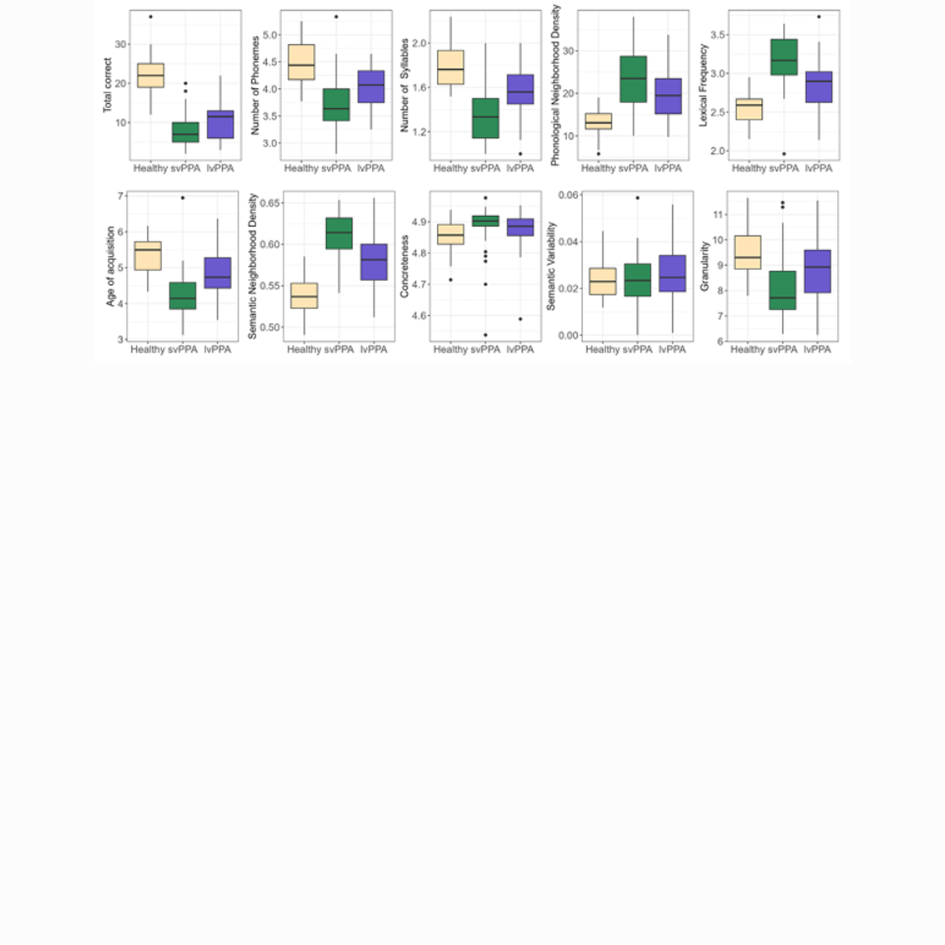
Methods: We analyzed animal fluency responses from 113 participants (40 svPPA, 40 lvPPA, 33 controls) using an automated pipeline extracting nine psycholinguistic features. Group differences were examined with (co)variance models, classification with logistic regression, and brain–behavior associations via structural magnetic resonance imaging.
Results: All features except semantic variability distinguished svPPA from lvPPA. Models including features outperformed (area under the curve [AUC] = 0.86) those using only total correct or clinical variables (AUC = 0.60–0.68). Features related mainly to temporal lobe atrophy, whereas total correct also related to the angular gyrus.
Discussion: Automated item-level analysis offers a sensitive, scalable method for supporting PPA diagnosis and monitoring.
To access the full paper, please click here.