Synchronous analysis of abnormal acoustic and linguistic production in Parkinson’s speech
Escobar-Grisales, D., Ríos-Urrego, C. D., Siniscalchi, M. S., García, A. M., Bocanegra, Y., Moreno, L., Nöth, E. & Orozco-Arroyave, J. R. (2025). Synchronous analysis of abnormal acoustic and linguistic production in Parkinson’s speech. Proceedings of Interspeech 2025, 5283–5287.
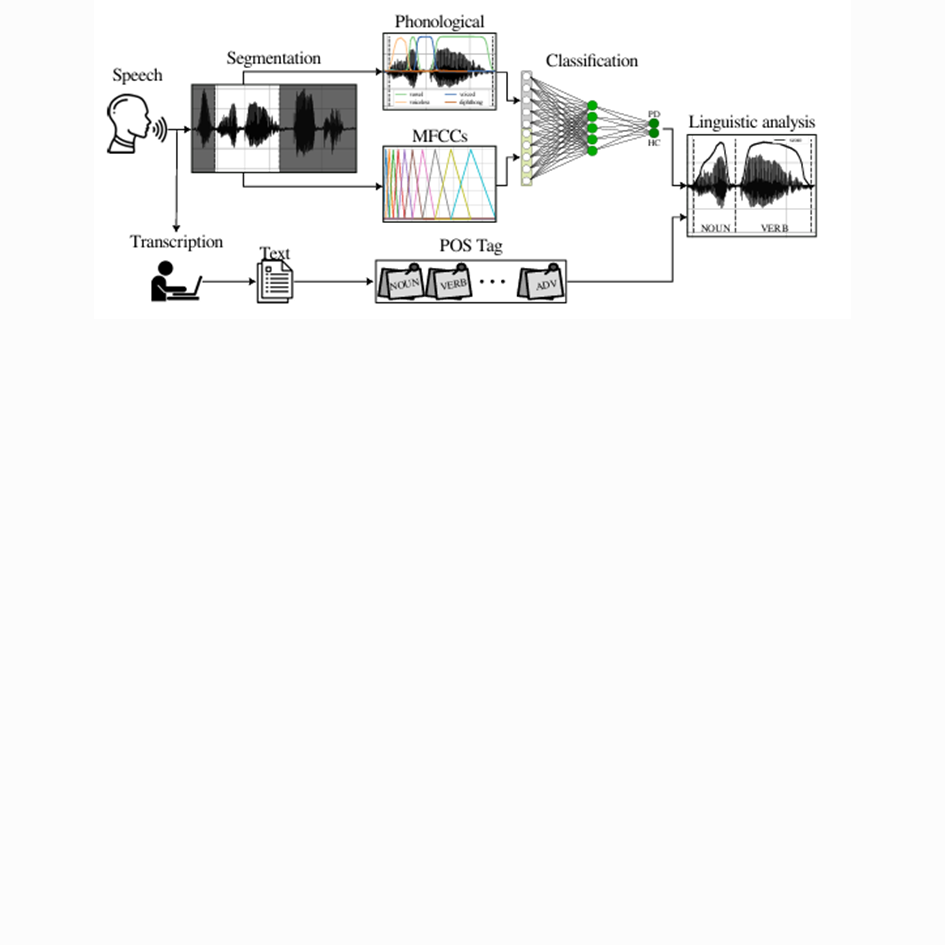
La enfermedad de Parkinson es un trastorno neurodegenerativo que conlleva déficits del habla y del lenguaje. A menudo, estos se estudian por separado como indicadores de los síntomas motores y no motores (por ejemplo, cognitivos), respectivamente. Por el contrario, las relaciones entre ambas dimensiones siguen siendo prácticamente desconocidas. Este artículo presenta una metodología que permite el estudio sincrónico de los patrones acústicos y lingüísticos en el habla de las personas con Parkinson. Nuestros hallazgos muestran que los verbos y los sustantivos proporcionaron información acústica y lingüística relevante no solo para modelar las alteraciones motoras, sino también para comprender los síntomas no motores, como los que aparecen cuando los pacientes con enfermedad de Parkinson desarrollan un deterioro cognitivo leve.
Para acceder al artículo, hacé click aquí.
Synchronous analysis of abnormal acoustic and linguistic production in Parkinson’s speech
Escobar-Grisales, D., Ríos-Urrego, C. D., Siniscalchi, M. S., García, A. M., Bocanegra, Y., Moreno, L., Nöth, E. & Orozco-Arroyave, J. R. (2025). Synchronous analysis of abnormal acoustic and linguistic production in Parkinson’s speech. Proceedings of Interspeech 2025, 5283–5287.
Parkinson’s disease is a neurodegenerative disorder involving speech and language deficits. Often, these are separately studied as proxies of motor and non-motor (e.g., cognitive) symptoms, respectively. Conversely, links between both dimensions remain virtually uncharted. This paper introduces a methodology that enables the synchronous study of acoustic and linguistic patterns in Parkinson’s speech. Our findings show that verbs and nouns provided relevant acoustic and linguistic information not only to model motor impairments but also to understand non-motor symptoms like those that appear when Parkinson’s disease patients develop mild cognitive impairment.
To access the full paper, please click here.